Tend Cell
A robot machine-tending cell that turns an idle second shift into spindle hours, on your existing machines.
What you get.
- Retrofits to machines you already own, ours or anyone else's.
- Cycle-time verified against the spec before handover, not after.
- Fixturing and offset management built for real high-mix changeover, not a demo part.
- Your operators are trained to re-teach it, so a new part number isn't a service call.
The numbers that matter.
Representative figures. Every machine is engineered to your parts, throughput and site. We confirm the exact spec during scoping.
- Machines served
- 1–2 per cell
- Payload
- 10 / 20 / 50 kg
- Reach
- 1,400–1,800 mm
- Part buffer
- Drawer, tray or conveyor
- Changeover
- Under 20 min, tooling dependent
- Safety
- Fenced or scanner-guarded, CE-marked
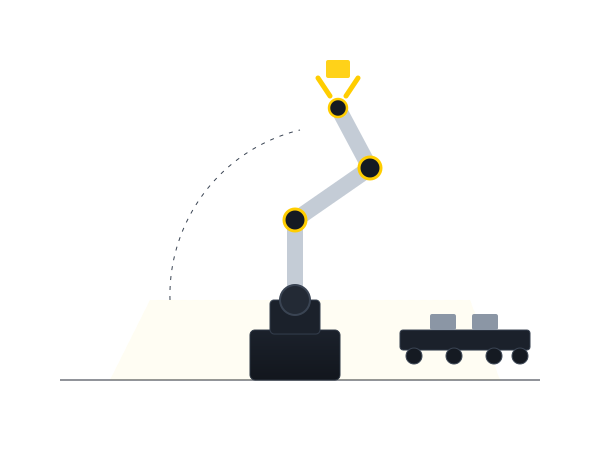
The Tend Cell is a robot that loads and unloads your machine so it can keep cutting when nobody's standing in front of it. It fits machines you already own, ours or anyone else's.
Start with the bottleneck, not the robot
A robot only creates value where it removes a constraint. Machine tending pays back fastest when the machine cycle is longer than the load/unload time, when work is high-mix but repeatable within a batch, and when you're turning away work or paying overtime because you can't staff a third shift.
If that's true, the machine is idle capacity you've already paid for. The robot just lets you use it. If it isn't true, a robot won't fix it, and we'll say so.
We've written up the maths we run with customers if you want to work it through before talking to anyone.
What actually determines payback
Three things move the payback date more than the robot's price tag:
- Uptime of the whole cell. A robot that stops every hour on a misload saves nobody. This is why we cycle-time-verify before handover.
- Changeover time. If switching parts takes half a shift, high-mix work erases the gains. Fixturing and offset management matter more than raw speed.
- What you do with the freed operator. The best outcomes redeploy people to inspection, setup and programming.
What's included
Robot and controller, gripper and fixturing designed for your parts, part buffer (drawer, tray or conveyor), machine interface and door automation, safety system and CE marking, cycle-time verification, and operator training that covers re-teaching for new parts.
Ready to talk Tend Cell?
Tell us what you make and where you want to take it. We'll scope the machinery, retrofit or cell that gets you there.